Linear B: Deciphering the Earliest Known Written Greek
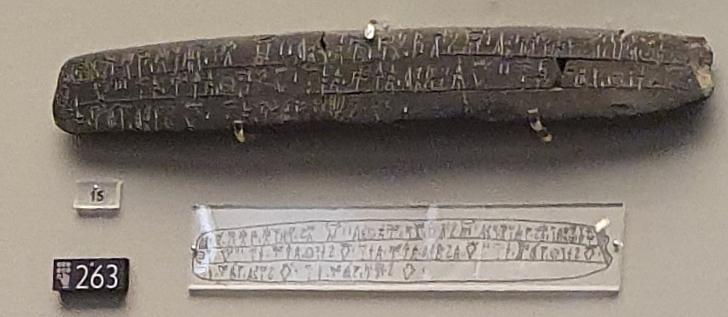
These clay tablets are 3,200 years old. They predate Homer by 600 years and the Greek alphabet by 400. They are the oldest known texts in any European language.
In 1952, a 30-year-old English architect named Michael Ventris announced he had deciphered the script on them. The language turned out to be Greek.
The Tablets
In 1900 at Knossos, Crete, British archaeologist Arthur Evans excavated the great Minoan palace and discovered thousands of clay tablets inscribed with an unknown script. He identified three writing systems: a hieroglyphic script, Linear A, and Linear B.
The tablets were mundane: inventories, lists, accounts. But they were written in an unknown language using unknown symbols, and Evans spent the rest of his life failing to read them. He jealously restricted access to the tablets, and progress stalled for decades.
The key break came not from Crete but from mainland Greece.
The Pylos Connection
In 1939, American archaeologist Carl Blegen began excavating at Pylos, on the southwestern coast of mainland Greece. On his very first day of digging, he found a room containing over 600 clay tablets, inscribed in Linear B.
This was explosive. Linear B wasn't just Cretan. It was used on the Greek mainland too, at a site that Homer called the kingdom of wise old Nestor. The palace Blegen uncovered, now called the Palace of Nestor, had been destroyed by fire around 1200 BCE, and the fire had accidentally baked the clay tablets, preserving them for three millennia.
The Pylos tablets were critical for decipherment for two reasons:
- They came from mainland Greece, not Crete. This raised the possibility that the language might be Greek, something Evans had always dismissed.
- They were found in archaeological context. Unlike the Knossos tablets (which Evans had excavated with poor record-keeping by modern standards), the Pylos tablets came from identifiable rooms with known functions: storerooms, an archive room, a tax office. You could make educated guesses about what the tablets should say based on where they were found.
The Detective: Michael Ventris
Michael Ventris became obsessed with Linear B at age 14, when he attended a lecture by Arthur Evans at the Royal Institution in 1936. He decided then that he would crack the script. He had no training in classics or linguistics; he was studying architecture. But he had a good ear for languages (he spoke six fluently by his twenties).
Ventris treated the problem like an engineering challenge. His method was systematic:
Step 1: Statistics
Working from published sign lists, Ventris tabulated every Linear B symbol and counted how often each appeared in different positions within words: beginning, middle, end. This is pure frequency analysis, the same technique used to break simple ciphers.
He noticed that certain signs appeared overwhelmingly at the beginning of words but rarely elsewhere. In languages with grammatical gender and case endings (like Greek or Latin), you'd expect the beginnings of words to be more constrained than the endings. This pattern suggested an inflected language.
Step 2: The Grid
Ventris created what he called a "grid", a table organizing the ~87 Linear B syllabic signs by their likely consonant and vowel values. Signs that shared a consonant (like ka, ke, ki, ko, ku) would show similar distribution patterns. He didn't know which consonant, just that they shared one.
The point: you don't need to know what the sounds are to group them by shared properties. It's unsupervised clustering, decades before the term existed.
Step 3: The Place Names
The breakthrough came from an American classicist, Alice Kober, who had done foundational work before her death in 1950. Kober identified "triplets", groups of three words that shared the same root but had different endings. She proved Linear B was an inflected language and began building the grid that Ventris would complete.
Ventris then tried something bold. He took place names that should appear on tablets from specific locations. A tablet from Knossos should mention Knossos. A tablet from Pylos should mention Pylos. If Linear B was a syllabic script (each sign = one syllable), he could try matching known place names to recurring sign groups.
He tried the ancient name for the Cretan town of Amnisos: a-mi-ni-so. Four syllables, four signs. He found a sign group on the Knossos tablets that appeared in the right frequency and context. If this was right, he now knew the sound values of four signs.
He plugged those values into other words. More words emerged. He tried ko-no-so (Knossos) and pa-i-to (Phaistos). They worked. Then he tried pu-ro for Pylos on the Pylos tablets. It fit.
And then the letters started producing Greek words.
Step 4: The Shock
Ventris had always assumed, like most scholars, that Linear B encoded a pre-Greek language, something related to Etruscan or an unknown Aegean tongue. He tried Greek almost as a joke.
But the words that emerged were Greek. Archaic, strange, 600 years older than any known Greek text, but unmistakably Greek:
| Linear B | Transcription | Greek | Meaning |
|---|---|---|---|
| 𐀴𐀪𐀠 | ti-ri-po | τρίπος (tripos) | tripod |
| 𐀕𐀏 | ko-wo | κόρϝος (korwos) | boy |
| 𐀕𐀷 | ko-wa | κόρϝα (korwa) | girl |
| 𐀷𐀩𐀐 | wa-na-ka | ϝάναξ (wanax) | king/lord |
| 𐀁𐀨𐀺 | e-ra-wo | ἔλαιϝον (elaiwon) | olive oil (!) |
That last one, e-ra-wo (olive oil), appears constantly on the Pylos tablets. The Palace of Nestor was tracking its olive oil inventory in Greek, 3,200 years ago.
The Confirmation
On 1 July 1952, Ventris announced his decipherment on a BBC Third Programme radio broadcast. Many scholars were skeptical. But then Carl Blegen, the excavator of Pylos, provided the decisive proof.
Blegen had recently found a new tablet at Pylos, not yet published, that Ventris had never seen. Using Ventris's values, the tablet described an inventory of tripod cauldrons and different types of vessels. Next to the text were pictograms, small drawings of exactly those objects: tripods with three legs, cups with varying numbers of handles.
The text described what the pictures showed. The decipherment was correct.
What the Tablets Reveal
The Pylos tablets are the records of a Bronze Age Greek bureaucracy. The palace controlled everything:
- Land allocation: Tablets record who held what fields, and whether the land was communal or private
- Livestock: Detailed counts of sheep, goats, pigs, and cattle assigned to individual herders
- Textiles: Wool quotas assigned to different workshops, with records of women workers and their children
- Military: Rosters of rowers for warships, watchers assigned to the coast, possibly preparing for the attack that would destroy the palace
- Religious offerings: Lists of goods dedicated to gods whose names we recognize (Poseidon, Zeus, Hera, Hermes), proving these gods were worshipped centuries before classical Greece
- Olive oil and wine: Enormous quantities tracked with obsessive detail: how much, from where, for what purpose
The palace at Pylos was destroyed around 1200 BCE, probably by invaders. The archive tablets survived only because the fire that consumed the palace baked the clay. We are reading the last accounting records of a civilization about to collapse.
The Tragedy
Michael Ventris died in a car crash on 6 September 1956, at age 34. He had collaborated with Cambridge linguist John Chadwick to publish Documents in Mycenaean Greek in 1956, the definitive work. But he never held a university position in the field he had revolutionized. He remained an architect.
Linear A, the script used by the Minoans before the Greeks took over Crete, remains undeciphered to this day. Whatever language the Minoans spoke, it died with them.
Further Reading
- Chadwick, John (1958). The Decipherment of Linear B. Cambridge University Press - The definitive account, by Ventris's collaborator
- Fox, Margalit (2013). The Riddle of the Labyrinth. HarperCollins - A brilliant retelling that gives Alice Kober her due
- CaLiBRA (Cambridge Linear B Research Archive) - Browse actual tablet transcriptions
- BBC: The man who deciphered Linear B - Short video on Ventris
- Blegen, C.W. & Rawson, M. (1966). The Palace of Nestor at Pylos in Western Messenia. Princeton University Press